How Currency Swings Reshape Deposit Timing Across Multi-Region Digital Betting Networks
Felix Müller · Aug 13, 2026

How Currency Swings Reshape Deposit Timing Across Multi-Region Digital Betting Networks
Currency fluctuations have altered deposit patterns in multi-region digital betting networks for years, and data from August 2026 shows continued adjustments as exchange rates move players to shift their funding windows. Operators track these changes through transaction logs that reveal clusters of activity when certain currencies strengthen or weaken against others, which creates windows where deposits yield more value in betting credits after conversion.
Mechanics of Exchange Rate Influence on Deposits
Digital betting platforms process payments in multiple currencies simultaneously, so a swing in the euro against the Australian dollar can prompt users in one region to delay or accelerate deposits while others proceed without change. Researchers monitoring forex data alongside platform analytics have noted that participants often align their actions with central bank announcements or market openings in major trading centers, because those moments tend to stabilize or exaggerate rate movements for short periods. Transaction records from networks spanning Europe, North America, and the Asia-Pacific demonstrate that users monitor live rates through third-party tools before committing funds, which stretches or compresses deposit peaks depending on the direction of the swing.
Payment processors integrated into these networks apply conversion fees that fluctuate with market volatility, and users respond by batching deposits during lower-fee intervals that coincide with favorable rates. Figures released by the Bank for International Settlements indicate that average daily turnover in major currency pairs reached levels in mid-2026 that directly correlate with observed spikes in cross-border betting deposits, particularly when the U.S. dollar moved against the Canadian dollar and the Japanese yen within the same trading session.
Regional Timing Adjustments Observed in 2026
Operators report that participants in Australia adjust deposit timing more frequently than those in stable-currency zones because the Australian dollar experiences sharper intraday movements against the U.S. dollar and euro. Data compiled through network analytics shows deposit volumes rising in the hours following Reserve Bank of Australia policy statements, while volumes dip when rates move unfavorably overnight. In contrast, users in Canada often time deposits around Bank of Canada updates, creating staggered patterns across the same global network that operators must balance through server capacity and fraud monitoring systems.
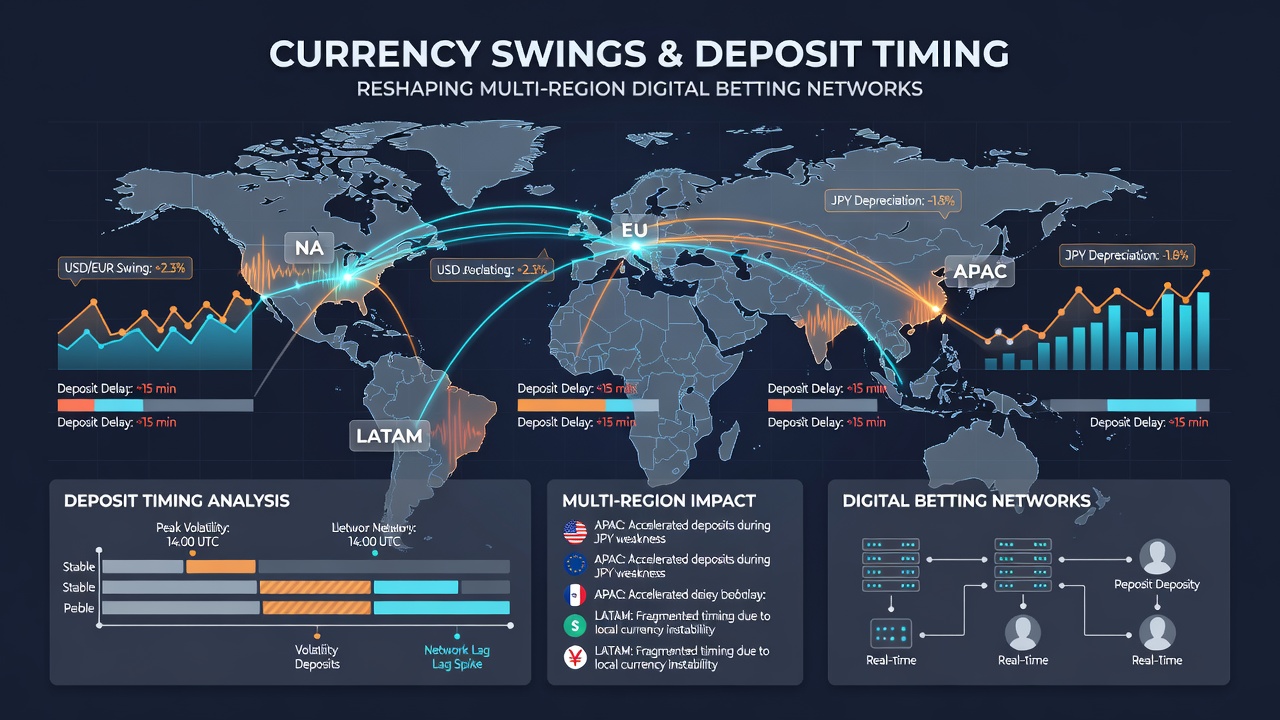
European users display different habits because the euro maintains tighter bands against several neighboring currencies, yet swings against the British pound and Swiss franc still trigger measurable shifts in deposit cadence. Platform logs from August 2026 reveal that deposit clusters in the Central European time zone align with London market open and Frankfurt trading hours, whereas North American users concentrate activity during New York session overlaps. These overlapping windows produce predictable surges that network engineers anticipate by scaling authentication servers and liquidity buffers in advance.
Impact on Network Operations and User Behavior
Multi-region networks maintain separate liquidity pools denominated in primary settlement currencies, and currency swings force periodic rebalancing that affects how quickly deposits clear into playable balances. When a major pair moves beyond historical averages, operators observe temporary backlogs in conversion queues that encourage some users to wait for the next trading day. Studies conducted by academic teams at institutions tracking digital finance have documented that these delays average between 45 and 90 minutes during high-volatility periods, which in turn shifts session start times for affected participants.
Payment method preferences also evolve under currency pressure. Users switch between bank transfers, e-wallets, and cryptocurrency options when traditional rails impose higher conversion spreads, and network data from 2026 shows elevated crypto deposit shares during weeks when fiat pairs exhibited above-average volatility. Observers note that these substitutions occur most often among users who maintain accounts across multiple jurisdictions, because they can route funds through the path offering the least friction at that moment.
Regulatory filings from bodies such as the Bank of Canada and the Reserve Bank of Australia provide the macroeconomic backdrop against which these micro-level deposit adjustments occur. The alignment between published exchange rate series and betting platform timestamps allows analysts to quantify how many minutes or hours users shift their activity in response to each percentage point of movement.
Conclusion
August 2026 data confirms that currency swings continue to drive measurable changes in deposit timing across multi-region digital betting networks. Operators respond with dynamic system scaling, while users adapt through rate monitoring and payment method rotation. These patterns emerge consistently from transaction records and forex benchmarks, illustrating a direct operational link between global currency markets and the day-to-day funding behavior of participants in interconnected betting environments.